How AI Marketing Automation Is Transforming Business Growth in 2026

Some links on this page may be affiliate links. If you purchase through them, Rank Nuro may earn a commission at no extra cost to you.
Introduction
Most businesses are still stuck in tedious manual marketing processes that drain time and resources, but what happened next surprised many businesses: ai marketing automation is reshaping growth strategies in 2026. The hidden advantage is how this technology streamlines complex campaigns, boosts customer engagement, and scales business results with unprecedented efficiency. This is where automation becomes powerful for marketers ready to leap ahead.
Why This Matters
In the competitive landscape of 2026, companies ignoring ai marketing automation risk falling behind faster, losing customers, and overspending on inefficient practices. The real reason this works is that AI integrates data-driven decisions with automation systems, delivering personalized customer experiences at scale – a feat impossible by manual efforts. Businesses adopting AI-driven workflows gain a significant competitive advantage and unlock new growth avenues.
The Problem
Before AI-driven solutions, marketing teams faced several challenges:
- Extensive time spent on repetitive tasks like campaign scheduling, data segmentation, and follow-ups.
- Inconsistent personalization leading to weaker customer engagement.
- Slow reaction times to market changes and consumer behavior.
- Fragmented toolsets that don’t communicate well.
Current Manual Process
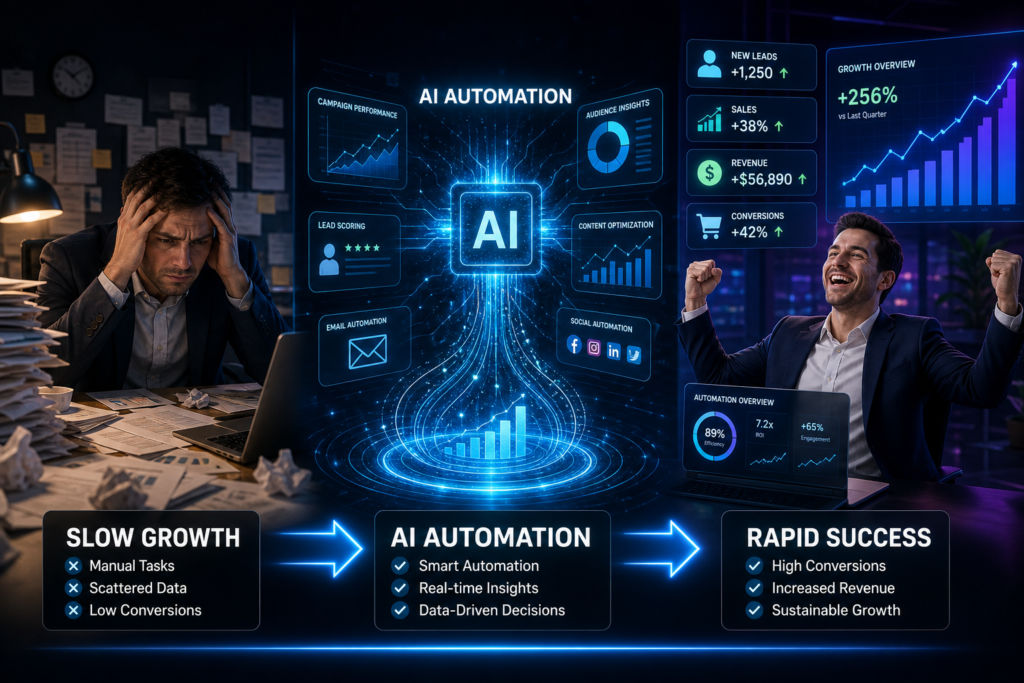
Imagine a marketing team manually creating email lists, analyzing customer data through spreadsheets, scheduling campaigns in isolated platforms, and drafting customer responses by hand. This process not only delays campaign launch but also limits the ability to flexibly adapt strategies based on real-time insights.
Why The Manual Process Fails
This outdated process leads to:
- Loss of valuable working hours on low-impact tasks.
- Decreased accuracy due to human error.
- Lower customer retention rates from unpersonalized touchpoints.
- Higher operational costs with reduced ROI.
AI Workflow Solution
The solution lies in integrating ai marketing automation with smart tools that seamlessly communicate and automate end-to-end marketing workflows.
Tools Required
- ChatGPT: For generating personalized content and customer interaction scripts.
- Make.com: No-code automation platform to connect marketing apps and automate workflows.
- Activepieces: Open source automation tool for workflow customization.
- ManyChat: For chat automation to engage customers in real-time.
- Chatbase: AI chatbot builder to customize interactions based on customer data.
Step-by-Step Guide
- Data Integration: Use Make.com to aggregate customer data from CRM systems and lead capture forms.
- Content Generation: Deploy ChatGPT to create dynamic email drafts, social media posts, and ads tailored to segmented audiences.
- Automated Campaign Launch: Set automated triggers in Activepieces that launch campaigns based on customer behavior signals like website visits or cart abandonment.
- Real-Time Engagement: Implement chatbots via ManyChat to provide instant responses and guide leads toward conversions.
- Performance Monitoring: Use dashboard integrations to track KPIs and dynamically adjust campaigns through the automation platform.
Real Business Example
Consider a mid-sized ecommerce business struggling with abandoned carts and low email open rates. By implementing an AI marketing automation workflow integrating Make.com for data sync, ChatGPT for personalized emails, and ManyChat for proactive customer chats, the company reduced cart abandonment by 25%, increased email CTR by 40%, and saved 15 hours weekly in manual tasks.
Expected Results
- Increased conversion rates by leveraging personalized AI content.
- Reduced operational costs due to automation of repetitive tasks.
- Improved customer satisfaction with rapid, intelligent engagement.
- Better agility to pivot marketing strategies based on real-time data.
Common Mistakes
- Attempting to automate without clear process mapping.
- Neglecting proper integration between tools, causing data siloes.
- Over-automation leading to loss of human touch.
- Not continuously monitoring AI outputs and campaign performance.
Tips And Best Practices
- Start small by automating the highest impact repetitive tasks.
- Choose tools that offer easy integration such as Make.com and Activepieces.
- Continuously test and optimize AI-generated content.
- Balance AI automation with personalized human interaction.
FAQ
Is AI marketing automation suitable for small businesses?
Absolutely. Many tools offer scalable solutions that fit small business budgets while significantly improving efficiency.
Can AI replace human marketers?
No, AI marketing automation is designed to augment and empower marketers by handling repetitive tasks and providing data insights, not replace creative human inputs.
Which AI tools work best for customer engagement automation?
Tools like ManyChat and Chatbase are excellent for implementing conversational AI to boost customer interaction.
Final Thoughts
Very few businesses are doing ai marketing automation correctly, but those who invest in building intelligent, integrated workflows gain a clear path to scalable and sustainable growth. The opportunity to transform your marketing efforts is here — leveraging tools like Make.com, ChatGPT, and ManyChat can be the game-changer your business needs to thrive in 2026 and beyond.