11 AI Sales Tools Transforming Business Growth in 2024

Introduction
Many businesses struggle with sluggish sales cycles, inefficient lead management, and rising customer expectations. In 2024, relying on traditional sales methods can cost companies time and money, limiting growth opportunities. But what if you could automate repetitive tasks, generate more leads, and close deals faster—all without expanding your sales team? The answer lies in the power of ai sales tools. These cutting-edge technologies are not just buzzwords; they are revolutionizing the way businesses grow, compete, and succeed.
Why This Matters
Sales functions are the backbone of revenue generation, yet many businesses lose countless hours to manual data entry, follow-ups, and inefficient workflows. Mismanaged prospect relationships and underutilized data mean missed opportunities. AI sales tools help close this gap by streamlining sales processes, improving customer engagement, and reducing costs.
The Business Problem
Sales teams face:
- Difficulty generating qualified leads
- Low conversion rates
- Time-consuming manual workflows
- Poor customer response times
- Lack of insight into prospects’ needs
Each of these issues translates to lost revenue and competitive disadvantage.
How AI Solves It
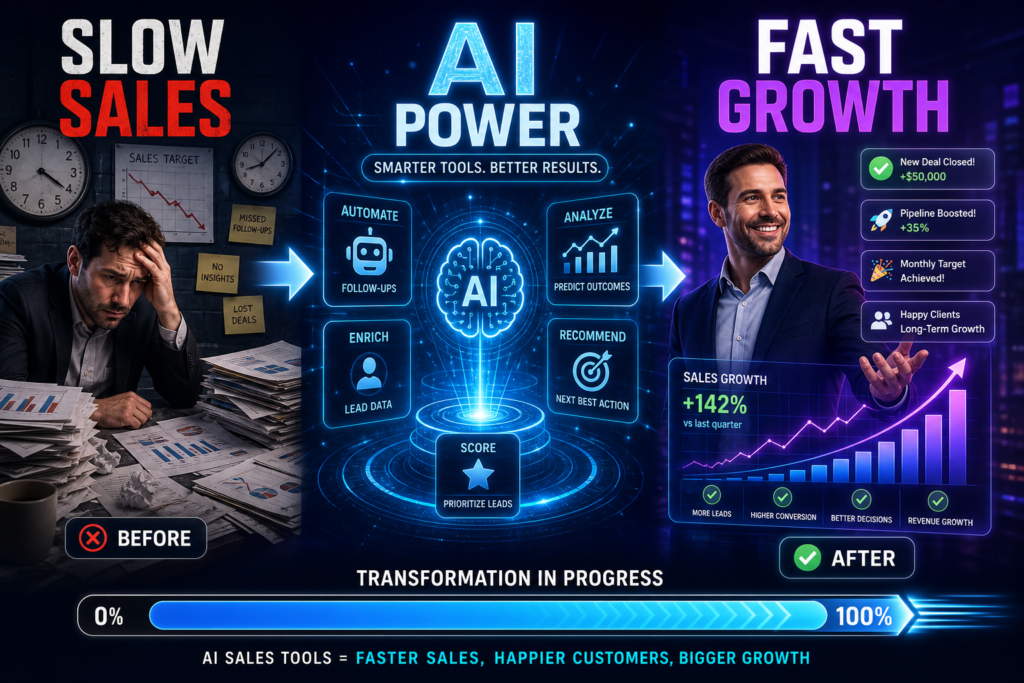
AI sales tools automate lead scoring, provide insightful customer data, enable personalized communication, and optimize sales pipelines. Integration with ai chatbot and ai assistant technologies enhances customer interaction by providing instant, 24/7 responses to inquiries. AI-powered CRMs streamline sales tasks, allowing reps to focus on closing deals.
AI Tools Required
- HubSpot: A versatile CRM platform that uses AI to automate lead generation and nurture sales pipelines efficiently.
- Pipedrive: An AI-driven CRM focused on sales pipeline management and forecasting.
- Close CRM: AI-enabled communication tools that help close deals faster with automated follow-up systems.
- Salesforce: A powerful AI-powered CRM leveraging data to predict and enhance sales outcomes.
- ChatGPT: Integrates with sales workflows to enable ai chat and automated customer support around the clock.
- Instantly: AI-powered cold email outreach platform for lead generation.
- Make.com: A no-code automation tool that connects sales apps and workflows seamlessly.
- Zapier: Automates repetitive sales tasks to improve productivity.
- Intercom: AI-powered conversational platform for customer engagement and support.
- Freshdesk: AI-enhanced customer support platform.
- Notion: Helps sales teams with AI-driven productivity and note-taking.
Step-by-Step Guide to Implementing AI Sales Tools
- Assess your sales process to identify bottlenecks and repetitive tasks.
- Choose the right AI sales tools like HubSpot for CRM and Make.com for automation based on your business size and needs.
- Integrate tools to unify your lead generation, communication, and sales tracking.
- Train your team on using AI features effectively, emphasizing the benefits for daily tasks.
- Monitor results with analytics and tweak automation workflows using platforms like Zapier.
- Continuously optimize by integrating advanced tools such as AI chatbots for enhanced customer engagement.
Real Business Example
A mid-sized software company integrated ai sales tools like HubSpot, Close CRM, and chatbot ai in their sales process. Within six months, they saw a 40% increase in qualified leads, 30% faster deal closure, and a 25% reduction in sales-related operational costs. Their customer support also improved with AI-powered chatbots maintaining engagement and resolving queries instantly.
Expected Results
By adopting AI sales tools, businesses can expect:
- Increased revenue through higher lead conversion rates
- More qualified lead generation
- Improved customer support and engagement
- Shorter sales cycles with automation
- Reduced operational costs
- Enhanced marketing and sales productivity
- Stronger competitive advantages
Common Mistakes to Avoid
- Choosing AI tools without clear alignment to your business goals
- Neglecting team training on AI integration
- Ignoring the importance of data quality for AI effectiveness
- Over-relying on AI without human oversight
- Failing to continuously monitor and optimize AI workflows
Growth Opportunities
After initial implementation, businesses can explore:
- Advanced ai marketing automation to further personalize outreach
- Integrating AI agents like Agent.ai and Lindy.ai for smart task delegation
- Leveraging AI-powered analytics for predictive sales forecasting
- Utilizing conversational AI platforms such as Voiceflow to create custom voice assistants that improve customer engagement
Final Thoughts
The rise of ai sales tools presents an unprecedented opportunity for businesses to accelerate growth, reduce costs, and enhance customer experiences. By strategically integrating AI-powered CRMs, automation platforms like Make.com and Zapier, and smart chatbots, companies can transform sales teams from overwhelmed to unstoppable. Embracing AI today means staying ahead of the competition tomorrow.