How AI Marketing Automation Is Transforming Business Growth in 2026

Some links on this page may be affiliate links. If you purchase through them, Rank Nuro may earn a commission at no extra cost to you.
Introduction
In 2026, businesses that ignore ai marketing automation risk falling behind their competitors. Most companies lose precious time and resources to manual marketing tasks that AI could automate seamlessly—this small change can dramatically improve results. Businesses embracing advanced AI marketing automation strategies are not just enhancing efficiency; they’re unlocking unprecedented growth opportunities and carving out a competitive advantage that is reshaping entire industries.
Why This Matters
Businesses today grapple with overwhelming data, complex customer journeys, and the constant pressure to deliver personalized marketing at scale. Manual marketing efforts are often slow, error-prone, and unable to respond dynamically to market changes. Very few businesses are doing this correctly, missing out on the hidden advantage AI-powered marketing automation offers: hyper-efficient, continuously optimized, and personalized customer engagement that accelerates business growth.
The Problem
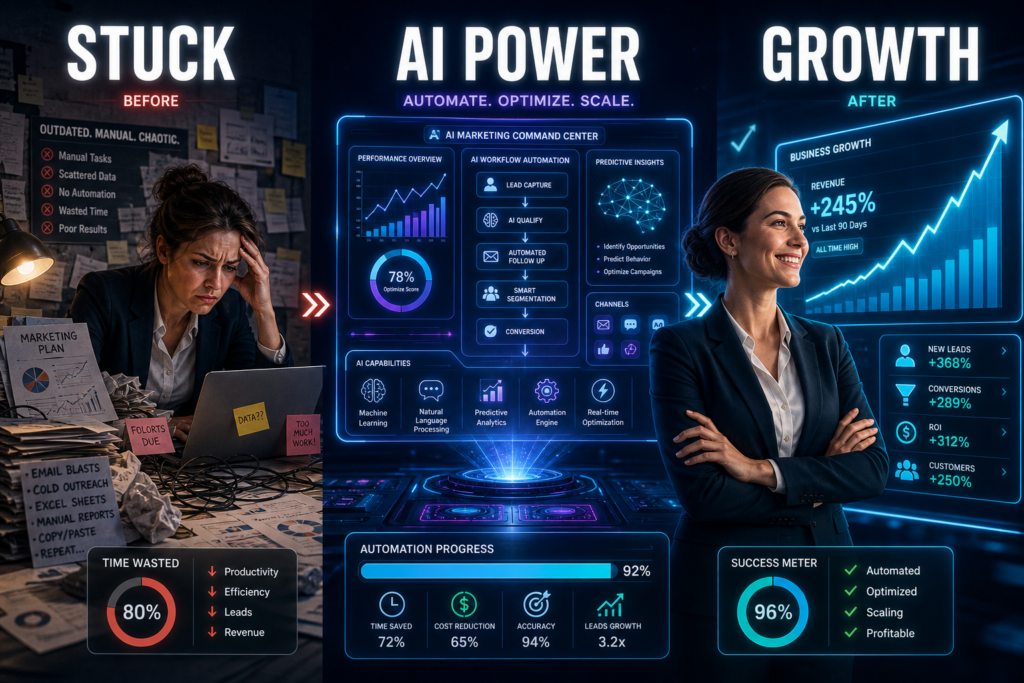
Many marketing teams waste countless hours on repetitive tasks like email segmentation, campaign scheduling, and lead scoring. These manual processes delay campaigns and increase operational costs, while also reducing response speed—key factors costing companies both revenue and customer loyalty.
Current Manual Process
Typically, marketing teams collect leads via web forms, manually sort and score these leads, segment email lists, and then schedule campaigns through separate email marketing software. This disconnected workflow means duplicated effort, increased errors, and slow execution. For example, a lead generated via a website form might sit unqualified for days before being included in personalized campaigns.
Why The Manual Process Fails
This fragmented approach lacks automation that can act instantaneously and intelligently. Human error further complicates lead qualification and targeting. Also, the inability to analyze large volumes of customer data in real-time cripples personalized marketing efforts and limits scalability.
AI Workflow Solution
Implementing an AI marketing automation workflow that integrates lead capture, qualification, segmentation, and personalized campaign delivery can transform business growth. The real reason this works is the synergy between AI’s predictive capabilities and seamless automation tools. This is where automation becomes powerful—AI analyzes data, scores leads, and triggers personalized campaigns automatically, increasing engagement and conversions.
Tools Required
- Make.com: A no-code automation platform to connect various marketing tools and automate workflows. (icon)
- ChatGPT: To generate personalized marketing copy and interact with leads intelligently.
- Typeform: For interactive lead capture forms integrated seamlessly into workflows.
- Airtable: To manage and analyze lead data with flexible database functionalities.
- Slack: To notify sales and marketing teams in real-time about qualified leads or campaign updates.
Step-by-Step Guide
- Lead Capture: Use Typeform to create interactive lead forms that feed data into your database.
- Lead Qualification: Integrate with ChatGPT using Make.com to automatically analyze and score leads based on set criteria.
- Segmentation: Leverage Airtable to organize leads into segments aligned with marketing personas.
- Personalized Campaigns: Use AI-powered content generation with ChatGPT to compose tailored emails and SMS messages.
- Automation and Notifications: Deploy Make.com to trigger campaign sequences and notify sales teams in Slack when hot leads are detected.
Real Business Example
A mid-sized e-commerce company implemented this AI marketing automation workflow to manage thousands of monthly leads. Within three months, their qualified lead response time dropped from 48 hours to under 15 minutes, conversion rates increased by 35%, and marketing operational costs declined by 20%. What happened next surprised many businesses—customer retention also improved due to highly personalized engagement.
Expected Results
- Improved lead qualification speed and accuracy
- Higher conversion rates due to personalized marketing
- Reduced manual labor and operational costs
- Faster marketing campaign deployment
- Increased sales team productivity
Common Mistakes
- Not defining clear lead scoring criteria before automation
- Failing to integrate tools properly, causing data silos
- Relying solely on automation without ongoing manual reviews
- Ignoring customer data privacy compliance
Tips And Best Practices
- Continuously monitor and refine lead scoring algorithms with AI insights
- Ensure seamless integration between Make.com and other tools for smooth workflows
- Use AI-generated personalized content to boost engagement authenticity
- Regularly update and segment data in Airtable to keep marketing relevant
FAQ
What is the biggest advantage of AI marketing automation?
It dramatically reduces manual tasks and increases marketing personalization at scale, resulting in faster lead conversion and business growth.
Do I need technical skills to implement this workflow?
Platforms like Make.com offer no-code automation, making it accessible for marketers without coding experience.
Is data privacy a concern with AI marketing automation?
Yes, it’s crucial to comply with regulations such as GDPR and CCPA while handling customer data in automated workflows.
Final Thoughts
The future of marketing in 2026 is undeniably tied to ai marketing automation. This approach offers a competitive advantage by streamlining lead management, boosting personalized engagement, and scaling business growth efficiently. Most guides never mention this, but combining Make.com, ChatGPT, and intelligent databases like Airtable creates a powerhouse marketing engine businesses can’t afford to miss. It’s time to automate smarter and grow faster.