How Conversational AI for Business Is Driving Revenue Growth Today

Introduction
Most businesses today wrestle with the challenge of engaging customers effectively while optimizing operational costs. Many still rely heavily on manual customer interactions, missing out on the potential of conversational AI for business to boost revenue, enhance lead generation, and streamline customer support. Why do so many struggle? Because the rapid evolution of AI technology demands not only investment but strategic implementation. This article uncovers how conversational AI is transforming business growth today and how you can implement these advances for competitive advantage.
Why This Matters
Businesses face rising customer expectations and fierce competition, often constrained by limited resources. Traditional methods fall short in scalability and personalization, leading to lost sales opportunities and higher operational costs. Conversational AI offers a bridge to these challenges by automating interactions with human-like intelligence, enabling businesses to improve marketing, sales, and customer support efficiently.
The Business Problem
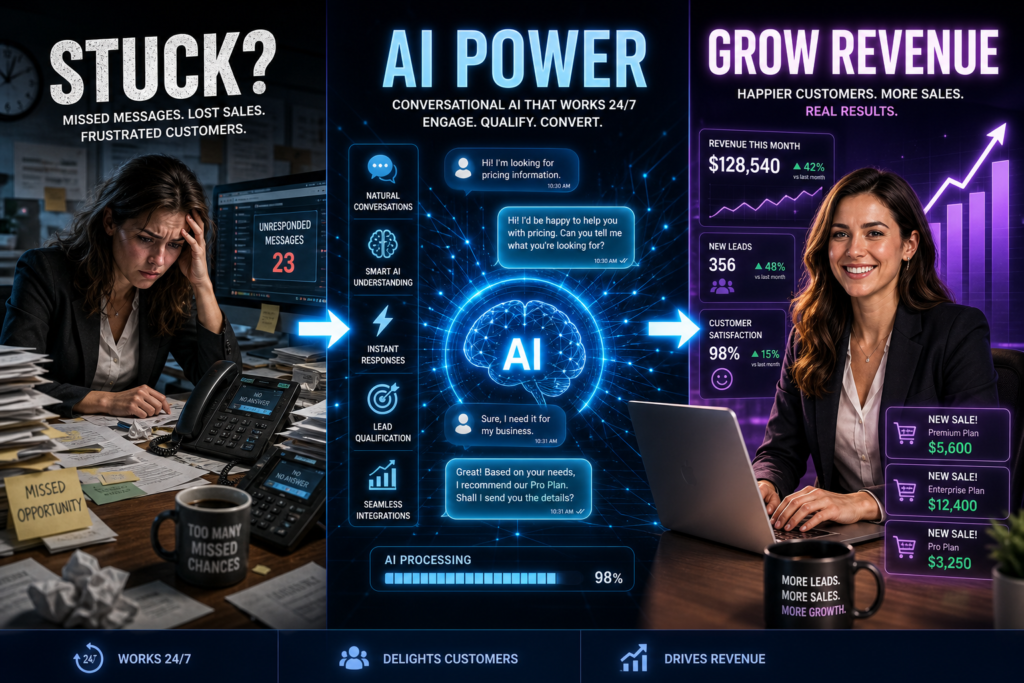
Businesses often lose potential customers due to slow response times and inconsistent service quality. Sales teams can be overwhelmed with routine queries, limiting focus on closing deals. Marketing campaigns may lack dynamic customer engagement, reducing lead conversion rates. Additionally, manual workflows increase cost and reduce productivity.
How AI Solves It
Conversational AI for business uses advanced natural language processing and machine learning to understand and respond to customer inquiries instantly, 24/7. Automated chatbots and virtual assistants deliver personalized communication, freeing human agents for complex tasks. This improves customer satisfaction, enhances lead qualification, and accelerates sales cycles. Moreover, integrating AI-powered automation tools reduces manual workload and operational expenses.
AI Tools Required
To harness conversational AI effectively, businesses rely on a suite of specialized tools:
- ChatGPT and Claude for sophisticated language understanding and content generation.
- HubSpot for comprehensive lead generation and CRM integration.
- Intercom and Zendesk to elevate customer support with AI chatbots.
- Pipedrive and Salesforce to optimize the sales pipeline.
- Automation platforms like Zapier and Make.com to seamlessly connect AI-driven workflows and increase productivity.
Step-by-Step Guide
- Identify business pain points: Determine where customer engagement, sales, or support can improve with automation.
- Select conversational AI tools: Choose platforms like ChatGPT for content generation and Intercom for chatbot integration.
- Integrate with current systems: Connect AI solutions with CRM and marketing tools such as HubSpot.
- Train AI models: Use your business data to customize AI responses for authentic and helpful interactions.
- Launch pilot programs: Test conversational AI in targeted scenarios to gather feedback and measure impact.
- Optimize and scale: Refine AI workflows, expand chatbot roles, and automate lead nurturing and follow-ups.
Real Business Example
A mid-sized eCommerce retailer implemented conversational AI through an ai chatbot integrated with HubSpot. The AI chatbot handled 65% of routine customer inquiries instantly, improving response times and satisfaction scores. Leads generated from chatbot conversations increased 40%, and sales conversion grew 25% within six months, all while reducing customer support costs significantly.
Expected Results
- Faster lead generation and qualification
- Improved customer retention through personalized interactions
- Reduction in operational costs with automated support
- Higher conversion rates in sales pipelines
- Increased marketing campaign efficiency
- Better workforce productivity by automating routine tasks
Common Mistakes
- Undervaluing the importance of training AI on specific business data
- Implementing AI without integration into existing systems
- Failing to monitor and optimize AI interactions continuously
- Ignoring customer feedback gathered through conversational AI channels
Growth Opportunities
After initial success, businesses can leverage advanced ai marketing automation to create dynamic campaigns that evolve based on customer behavior. Multi-agent AI systems like CrewAI can orchestrate complex workflows that span sales, support, and marketing. Additionally, voice-activated ai voice generator assistants can add new channels for customer interaction, enhancing engagement further.
Final Thoughts
Conversational AI for business is no longer a futuristic concept — it is a practical, transformative tool driving substantial revenue growth today. By automating routine customer interactions, increasing lead generation, and improving sales efficiency, businesses gain a powerful competitive edge. Adopting the right AI tools with a strategic implementation plan allows companies to not only save costs but also unlock untapped potential for growth and market leadership.