11 AI Sales Tools Transforming Business Growth in 2024

Introduction
Most sales teams still waste hours on routine tasks, manual lead follow-ups, and slow customer responses. As businesses grapple with rising competition and increasing customer expectations, many struggle to close deals quickly and efficiently. The lag in adopting modern technologies leaves revenue on the table and growth stunted. However, in 2024, ai sales tools are revolutionizing how companies generate leads, nurture prospects, and close sales faster — offering a clear path to boosting revenue and competitive edge.
Why This Matters
Sales is the lifeblood of every business. Inefficient processes inflate costs, delay deal cycles, and frustrate customers. Businesses that fail to modernize lose market share to competitors leveraging ai sales tools to optimize every stage of the funnel. Understanding and deploying these tools is no longer optional; it’s essential for sustainable growth and operational excellence.
The Business Problem
Manual outreach, unprioritized leads, inconsistent follow-ups, and disconnected data systems plague sales departments. These issues cause lost opportunities and overworked reps. The traditional sales approach is too slow and reactive to today’s fast-paced market demands.
How AI Solves It
AI empowers sales teams with automation, predictive insights, personalized engagement, and seamless data integration. Using AI tools means:
- Identifying high-potential leads through data analysis
- Automating repetitive outreach and follow-ups
- Personalizing communication to increase engagement
- Providing real-time analytics to optimize sales strategies
- Integrating customer data across platforms for a unified experience
AI Tools Required
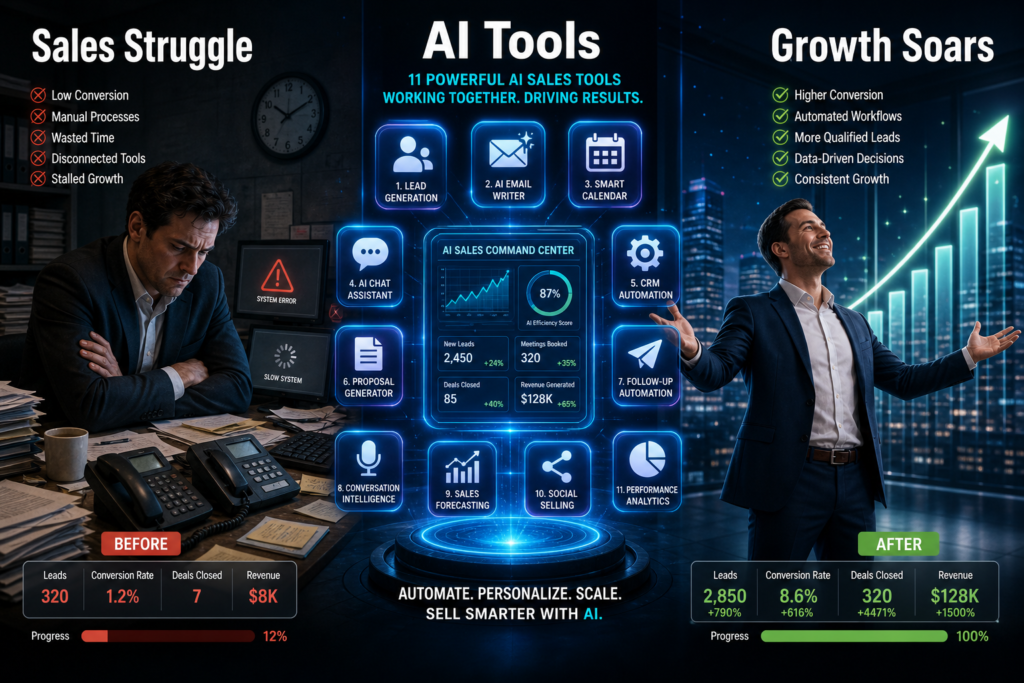
Here are 11 AI sales tools transforming businesses in 2024 and how they fit into your sales growth strategy:
- HubSpot: All-in-one CRM with AI that improves lead management, automates email sequences, and tracks engagement, helping sales teams stay organized and responsive.
- Pipedrive: AI-driven sales pipeline tool that prioritizes deals, forecasts revenue, and automates activity reminders.
- Close CRM: Designed for calling and emailing, it uses AI to analyze calls and recommend next steps, improving conversion rates.
- Salesforce: Robust AI features in Einstein Sales Cloud provide predictive scoring, opportunity insights, and AI-powered chatbots to assist reps.
- ChatGPT: Utilized as an AI assistant to generate personalized outreach emails and answer sales queries instantly.
- Apollo: Offers AI-powered lead generation and prospecting to build targeted lists quickly.
- Instantly: Marketing automation software that sends behavior-based follow-ups automatically to nurture leads.
- Make.com: No-code automation platform that integrates various sales tools, streamlining workflow and data syncing.
- Zapier: Automates repetitive tasks between apps, ensuring sales teams spend more time selling.
- Intercom: AI chatbots that engage and qualify leads on your site in real-time, enhancing customer support and initial contact.
- Zendesk: AI-enhanced customer support that resolves issues faster, improving sales follow-up readiness.
Step-by-Step Implementation
- Assess Sales Workflow: Map out your current process and identify bottlenecks.
- Select Tools: Choose AI tools aligned with your specific sales challenges and business size.
- Integrate Systems: Use automation platforms like Make.com or Zapier to connect your CRM, email, and chat systems.
- Train Team: Provide training on AI tools focusing on ease of use and benefits to adoption.
- Monitor and Optimize: Track KPIs like lead conversion, response times, and sales cycle length. Adjust AI workflows based on data insights.
Real Business Example
A mid-sized SaaS company integrated HubSpot and ChatGPT for their sales and marketing. By automating lead scoring and personalized email campaigns, they increased lead-to-customer conversion by 35% in six months, while reducing manual outreach time by 50%.
Expected Results
- Faster lead qualification and pipeline movement
- Increased sales productivity with automated tasks
- Improved customer engagement and satisfaction
- Data-driven decision making for revenue growth
- Lower cost per acquisition through targeted outreach
Common Mistakes
- Choosing too many tools causing complexity
- Lack of team training leading to underutilization
- Ignoring data integration preventing a unified sales view
- Failing to measure and optimize AI implementation
Growth Opportunities
Once foundational AI sales tools are in place, advanced opportunities like AI-driven predictive analytics, multi-agent AI workflows, and voice-enabled sales assistants can further scale your efforts. Tools such as Agent.ai and Relevance AI offer sophisticated automation that transform sales from reactive to proactive.
Final Thoughts
Adopting ai sales tools in 2024 is no longer just a competitive advantage; it’s a necessity. These tools streamline sales processes, enrich customer interactions, and open new growth channels. By choosing the right AI solutions and implementing them thoughtfully, businesses can unlock unprecedented revenue potential and market leadership.